We are pleased to announce the first release of SlideIO Viewer, a desktop application for opening and navigating whole-slide images. It reads every format the SlideIO library supports, runs on Windows, macOS and Linux, and requires no programming at all.
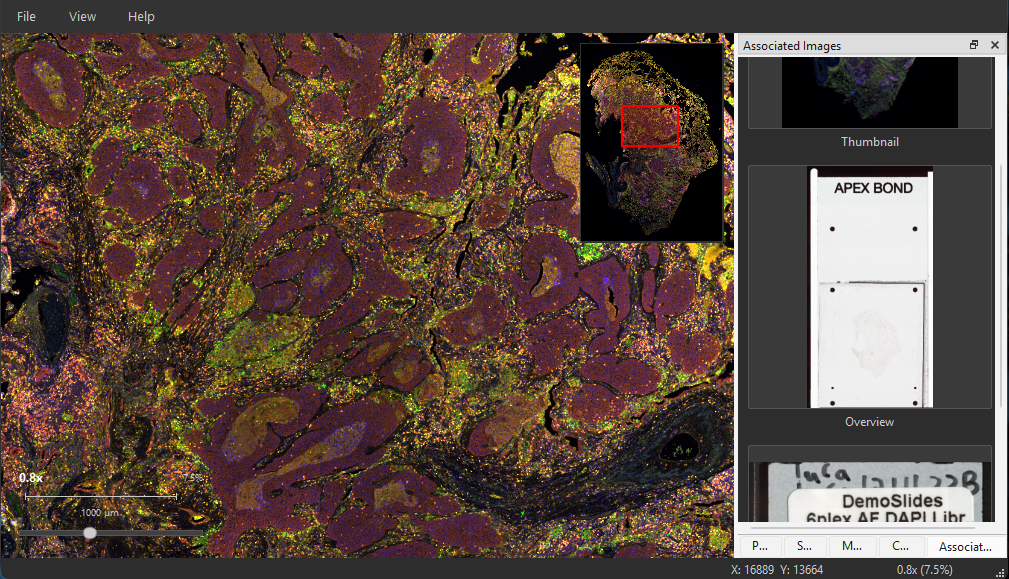
What it does
Until now, looking at a slide with SlideIO meant writing code. The viewer closes that gap. Open a file and the whole slide is there, rendered through the GPU and read from the zoom pyramid stored inside it, so panning and zooming stay smooth on images far larger than memory. Tiles load asynchronously: the picture stays responsive while the next level of detail arrives.
Beyond the image itself, the viewer surfaces what the file carries around it:
- Associated images — the thumbnail, slide overview and label scanned alongside the tissue.
- Slide properties and metadata — magnification, resolution, pixel format, and the raw format-specific metadata.
- Channels — per-channel visibility, colour and intensity with a histogram, for fluorescent and multiplexed slides.
- Scenes — slides holding several scanned regions list them as thumbnails.
- Z-stacks and time series — navigation through the Z and T dimensions of 3D and time-lapse data sets.
- A minimap and a scale bar, with the slide coordinates under the cursor.
Formats
The viewer inherits the library’s format support: Aperio SVS and AFI, Leica SCN, Zeiss CZI and ZVI, Hamamatsu NDPI, Olympus VSI, DICOM whole-slide images, PerkinElmer QPTIFF, OME-TIFF, Philips TIFF, and ordinary TIFF, PNG and JPEG images.
Getting it
Packages are available for Windows, macOS and Linux. Everything the application needs, Qt included, ships inside the package — there is no separate SlideIO installation and nothing to compile. A GPU capable of OpenGL 3.3 is required, which covers any graphics hardware of the last decade.
- Download SlideIO Viewer
- Viewer page — features, keyboard shortcuts and the full list of packages
- All SlideIO downloads
The Windows installer and the macOS disk image are not signed by a registered developer, so both systems will warn on first run. The release page explains how to proceed on each.
A first release
This is version 0.1.0, and the version number is meant honestly: the viewer is new, and we expect to find rough edges in it that no amount of testing at home would have shown. Please report them on the issue tracker — a file that fails to open, or opens wrongly, is the most useful bug report of all.
The viewer is built on SlideIO 2.10.0, whose parallel block reads are what let it decode several tiles at once. It is open source under the same BSD 3-clause license as the library, at github.com/Booritas/slideio-view.